In short
Crystalline silica free (CSF) quartz contains under 1% crystalline silica, against 85–95% in conventional engineered quartz. It looks and performs like conventional quartz and is cut with the same tooling. It reduces the specific hazard that regulators are acting on — but it does not remove any dust control duty, and it does not make a material legal in Australia, where the ban applies regardless of silica content.
What crystalline silica actually is
Crystalline silica occurs naturally in quartz, sand and many stones. Conventional engineered quartz is largely natural quartz bound with resin, so it contains a high proportion of it. In slab form it is inert and entirely safe to live with.
The hazard appears when the material is cut, ground or polished. That releases respirable crystalline silica, fine enough to reach deep into the lungs, and prolonged exposure is associated with silicosis, an irreversible scarring of lung tissue.
Why this became urgent
Cases of silicosis among engineered stone fabricators rose sharply over the last decade, particularly where dry cutting was common and extraction was poor. Regulators responded. Australia moved to prohibit engineered stone containing crystalline silica, and workplace exposure limits have tightened in the United States and across Europe.
The consequence for anyone buying or specifying is straightforward: the silica content of a surface is now a compliance question, not only a health one.
What CSF changes
Crystalline silica free quartz replaces the crystalline silica content with alternative minerals. The finished surface behaves much as conventional quartz does. It is non-porous, hard-wearing, and available in the same designs and finishes.
What changes is the dust. Cutting CSF material does not generate respirable crystalline silica, which removes the exposure at source rather than managing it downstream.
What does not change
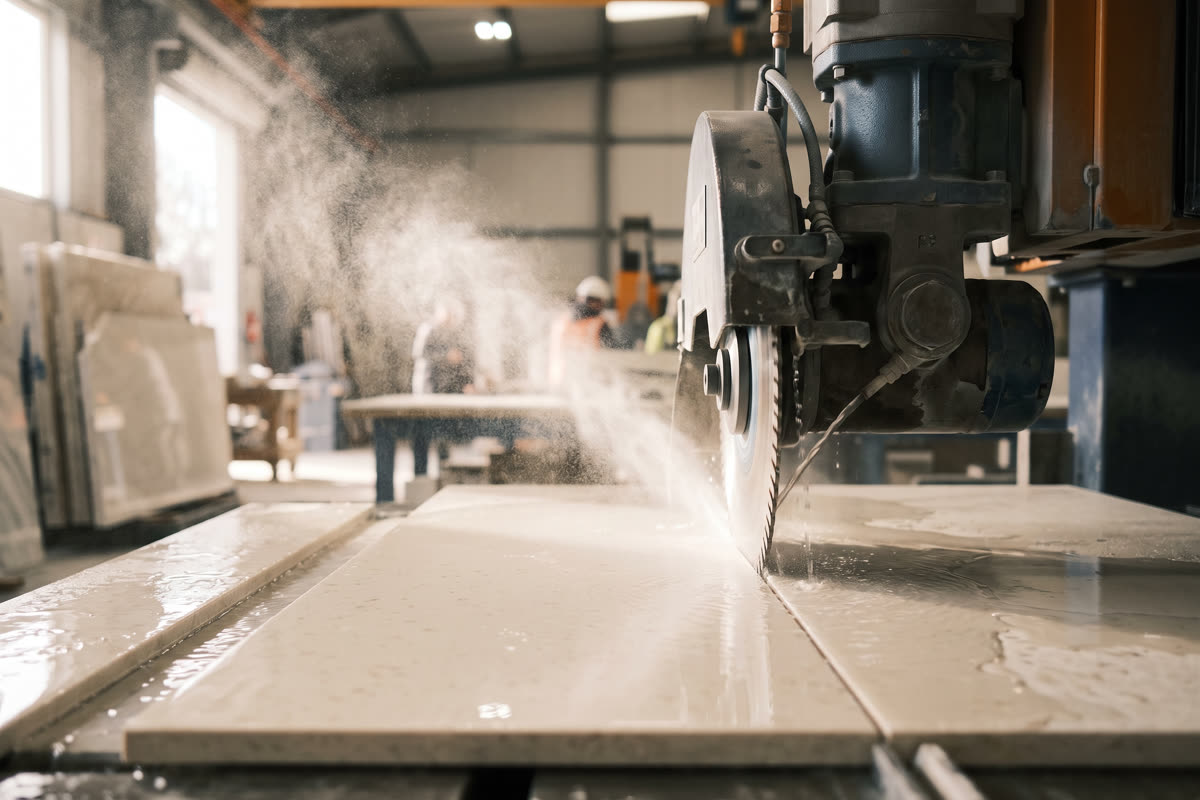
CSF is not a reason to abandon good workshop practice. Cutting any engineered surface produces dust, and wet cutting, extraction and respiratory protection remain necessary. The risk profile of that dust is different; the need to control it is not.
Nor is CSF automatically required everywhere. Many markets still permit conventional quartz, and plenty of fabricators run it safely with proper controls.
Questions worth asking a supplier
- Is CSF offered across the full range, or only on selected designs?
- Can the same design be supplied in both standard and CSF, so a specification does not have to change if regulation does?
- What documentation comes with it, and will it satisfy the market you are selling into?
- Does the appearance match the standard version closely enough to mix on a project?
Frequently asked questions
- What is crystalline silica free quartz?
- Crystalline silica free, usually shortened to CSF, describes engineered stone manufactured with under 1% crystalline silica. Conventional engineered quartz commonly contains 85% to 95%, which is the source of the respirable dust hazard when slabs are cut.
- Does CSF quartz look or perform differently from conventional quartz?
- No. It is specified, finished and installed the same way, in the same designs and formats, and is cut with the same diamond tooling. The difference is in what the dust contains.
- Do fabricators still need dust control when cutting CSF?
- Yes. Cutting any stone produces respirable dust, and duties under COSHH or equivalent legislation are unchanged. Water suppression, extraction, fit-tested RPE and health surveillance all still apply.
- Is CSF quartz allowed in Australia?
- No. Australia's ban, in force since 1 July 2024, applies to all engineered stone regardless of crystalline silica content, so a low or zero silica product does not re-enter that market on the strength of its silica figure.
Crystalline silica free is available on any SUNEX design, alongside standard quartz, so the choice does not restrict which surface you can specify. See the range or request samples.