Home Catalogue Applications Why SUNEX FAQs Blog Request Samples
Trade & specification · sales@sunexstones.com
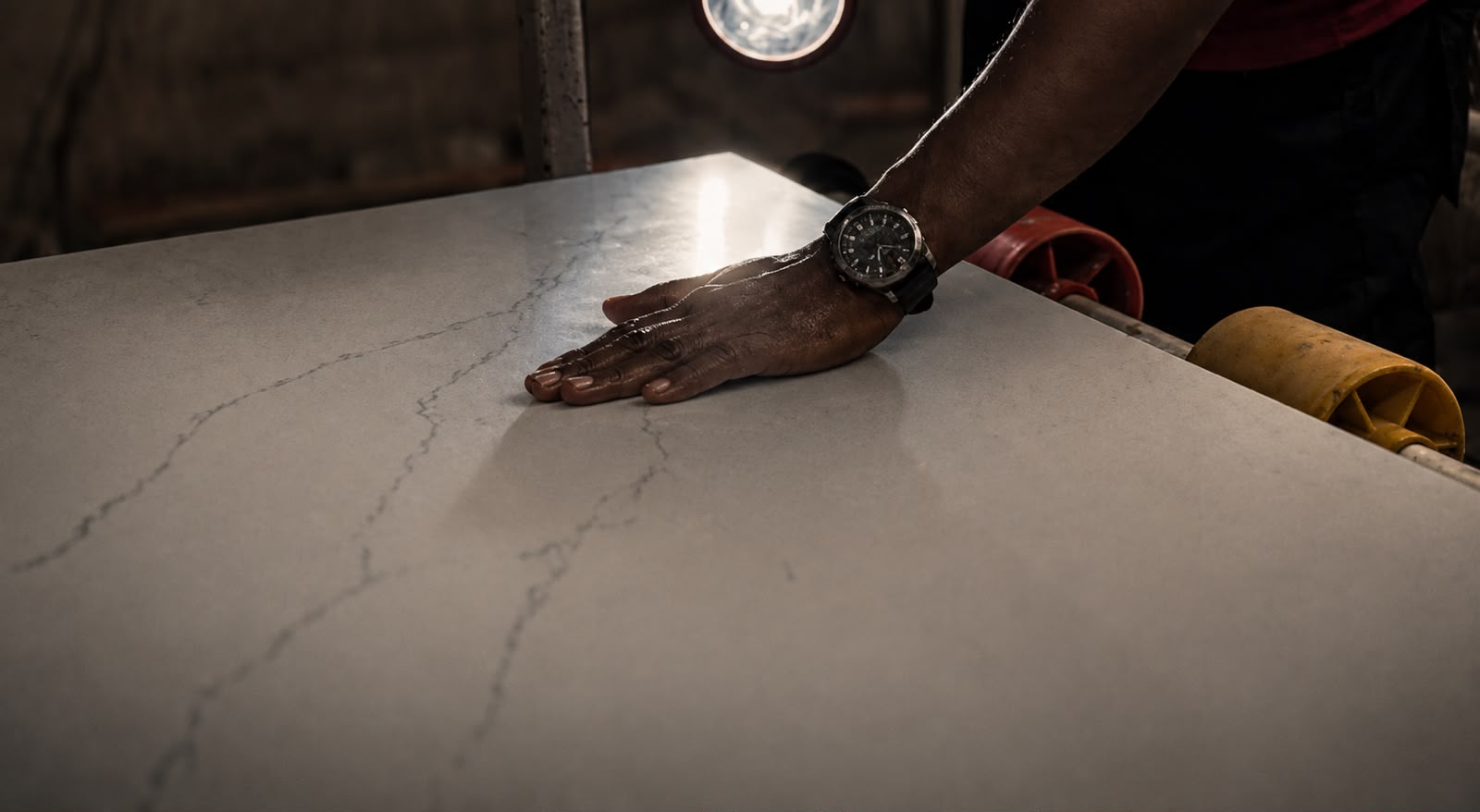
A hand resting on a finished SUNEX engineered quartz slab during quality inspection

Frequently asked
questions.

Answers for the distributors, fabricators, and specifiers we work with, covering the material, formats and finishes, samples, orders, export, and technical support.

The material

Engineered quartz is a man-made surface produced from roughly 90% natural quartz combined with high-quality resins and pigments. The result is a dense, non-porous material that offers the beauty of natural stone with far greater consistency, strength and everyday resilience.
CSF stands for Crystalline Silica-Free. Conventional quartz contains crystalline silica, which becomes a respirable hazard for fabricators when slabs are cut and polished. SUNEX CSF surfaces are engineered without crystalline silica, so fabricators and installers can work them with far lower health risk while the finished surface keeps the same appearance, durability, and performance. For distributors and specifiers, CSF also helps meet the tightening workplace-safety regulations now in force in markets such as Australia and parts of the USA.
It offers the look of natural marble with far greater slab-to-slab consistency and much better resistance to staining and etching. For volume orders and matched installations, that predictability is easier to specify and fabricate than natural stone.
Both are hard-wearing, but quartz is non-porous and never needs sealing, whereas granite is porous and requires periodic sealing to resist stains. Quartz also offers more consistent colour and veining from slab to slab, which makes large or matched installations far more predictable.
Our range spans 39 engineered quartz designs across Calacatta, Statuario, and signature collections, from whites and creams to darker tones. Browse the full range on the Catalogue page and request samples of any design to assess tone and veining first-hand.
Every SUNEX surface is produced in two jumbo formats, Jumbo (128 × 65 in) and Super Jumbo (138 × 79 in), in both 2 cm and 3 cm thicknesses. The larger format means greater yield and fewer joins across worktops, islands, and feature walls.
Every design is offered in Polished, Matt, and Leather, so a single design can carry across different applications without switching material.

Cost, comparison & value

The cost of quartz countertops depends on the design you choose, the slab thickness and finish, the total area (usually priced per square foot or square metre), the edge profiles and fabrication, and your delivery location. As an engineered-quartz manufacturer, SUNEX supplies distributors, fabricators and specifiers directly, so we quote to your actual project rather than a fixed retail price, which usually means better value on larger orders. Share your selected designs and quantities and our team will prepare a tailored quote.
Both are hard-wearing, but they suit different priorities. Engineered quartz is non-porous, so it never needs sealing and resists stains from wine, coffee and oil, and it keeps consistent colour and veining from slab to slab, a real advantage for large or book-matched installations. Granite is a natural stone with beautiful one-off variation, but it’s porous and needs periodic sealing. Choose quartz for low-maintenance consistency and predictable results; choose granite if you specifically want the uniqueness of natural stone.
For most kitchens and high-use spaces, yes. Engineered quartz is non-porous, highly scratch- and stain-resistant and never needs sealing, so it keeps its finish with very little upkeep and typically lasts for decades, spreading the cost over a long, low-maintenance lifespan. Because every SUNEX slab is engineered to a consistent standard and is CSF (Crystalline Silica-Free), you also get dependable quality and a safer surface to fabricate and live with. If you’d like to judge that quality first-hand, we’re glad to send full-size samples.

Performance & everyday use

Yes. Engineered quartz is non-porous, highly scratch- and stain-resistant, and never needs sealing, which makes it well suited to worktops, islands, and other high-use surfaces in both residential and commercial projects.
Very. Quartz resists scratches and everyday stains, and because it’s non-porous it won’t absorb liquids like wine, coffee or oil the way natural stone can. Wipe up spills as they happen and the surface stays looking new.
Quartz is heat-resistant but not heat-proof. Sudden or extreme heat can mark any engineered surface, so a trivet or pad under hot cookware is recommended to protect the finish over time.
Yes. The non-porous surface gives bacteria and moisture nowhere to settle, which makes SUNEX quartz easy to keep clean and well suited to kitchens, food-preparation areas and bathrooms.
SUNEX quartz is engineered for interior applications. Prolonged direct sunlight can affect the colour of any engineered quartz over time, so for outdoor or heavily UV-exposed projects we’ll be glad to advise on the right specification.
From kitchen worktops and waterfall islands to vanities, full-height cladding, reception desks, feature walls, and commercial interiors. One material across residential and contract projects.
No. Engineered quartz is non-porous, so unlike marble or granite it never needs sealing — and it should not be sealed. A sealant cannot soak into a non-porous surface, so it sits on top, builds up, holds dirt and leaves the surface looking dull. Warm water and a mild detergent is the whole maintenance routine.
Light surface marks can often be removed by a fabricator. Chips at an edge and heat damage are harder, because the resin that binds the stone cannot simply be polished back, and a repair usually needs a professional with colour-matched resin. Edges and corners are the vulnerable points, so they are worth protecting during installation and use.
Avoid anything strongly acidic or alkaline — oven cleaner, drain cleaner, bleach, descalers and solvents such as acetone or paint stripper. Also avoid abrasive pads and scouring powders, which dull a polished finish. If a harsh product does reach the surface, rinse it off with water immediately rather than wiping it around.

Samples, pricing & orders

Yes. Use the Request Samples page to share your project or business details and we will arrange full-size swatches, so your team can assess tone, veining, and finish before specifying or ordering.
No. Samples are provided free of charge. Share your details on the Request Samples page and we will arrange delivery.
Pricing depends on design, finish, volume, and destination. Share your requirements or the designs you are interested in and our team will prepare a quote. Email sales@sunexstones.com or use the Request Samples form.
Order quantities vary by market and by whether you are a fabricator, dealer, or distributor. Tell us about your business or project and we will advise on the right order size and terms.
Get in touch with our team by email or phone with your selected designs, finishes and quantities, and we’ll take you through availability, lead times and delivery for your location. For any product inquiries or order requirements, you can also reach us directly at sales@sunexstones.com.

Dealers, trade & export

Yes. SUNEX exports to markets including the USA, UAE, and UK, with the USA as our primary market, and we continue to expand our distribution footprint. Tell us your market and volume and we will advise on availability, lead times, and shipping.
We work with dealers and distributors in India and abroad, and we’re always open to new partners. If you’d like to stock or represent SUNEX surfaces, contact our team at sales@sunexstones.com to discuss opportunities in your region.
Yes. We support architects, interior designers, and specifiers with samples, technical specifications, and project guidance so SUNEX can be specified with confidence.
Lead times depend on the design, quantity and destination. Once we understand your requirements we’ll confirm current availability and a realistic delivery schedule for your project.
Jumbo and super-jumbo slabs are packed in protective export-grade crating for safe transit by road and sea. Our team will confirm packing and logistics details for your destination when you order.
As at September 2026, quartz surface products from India entering the United States carry antidumping and countervailing duties, continued in January 2026, plus safeguard tariffs introduced on 15 August 2026. The importer of record pays them on entry, not the manufacturer, so they affect landed cost rather than the ex-works price. Rates depend on the product and the entry date, so confirm the current position with your customs broker before committing to a shipment.
We quote on the terms that suit the buyer, most commonly FOB or CIF for container shipments. Tell us the destination port and whether you want us to arrange freight and insurance, and we will quote accordingly.
It depends on the market, the volume committed and whether anyone already represents us there. Territory arrangements, marketing support and sample provision are all part of the conversation rather than a fixed package. Tell us the market you cover and we will set out what is available in it.

Fabrication, care & company

SUNEX manufactures and supplies full jumbo and super-jumbo quartz slabs. Cutting, edge profiling, and installation are handled by your local fabricator or our partners, and we are happy to share fabrication guidance to support the best result.
Day-to-day cleaning needs only warm water and a mild detergent. Avoid abrasive pads and harsh solvents, and use a trivet under very hot cookware to protect the finish over time.
Yes. Slab dimensions, thicknesses, finishes and material data are available on the Catalogue page, and further documentation can be shared on request for specification and installation.
SUNEX surfaces are made to an exacting standard and are backed by a warranty. Contact our team for the current warranty terms and what’s covered in your market.
SUNEX Stones Private Limited was founded in 2017 and manufactures in Jaipur, Rajasthan. Reach us at sales@sunexstones.com, info@sunexstones.com, or +91 92570 64309. We are glad to help.

Specification & regulation

It depends on the country. Australia has prohibited engineered stone outright since 1 July 2024, regardless of silica content. In the United States there is no national ban; California has the STOP Act in force since January 2026 and, after a Cal/OSHA Standards Board vote on 21 May 2026, a standard banning engineered stone above 1% crystalline silica is being drafted. The United Kingdom is not planning a ban and is enforcing dust controls instead. Our guide to engineered stone silica rules sets out the current position in each.
Our CSF range is manufactured to be crystalline silica free, against roughly 85% to 95% in conventional engineered quartz. Because this figure now belongs in a specification and may be checked by a regulator, we will confirm the crystalline silica content for the specific product in writing rather than leave you relying on a marketing term.
They are shorthand for crystalline silica content. Q40 means under 40% and Q10 means under 10%, both large reductions from conventional engineered quartz. Crystalline silica free is the lowest tier, under 1%, which is the threshold California's proposed standard is written around.
It carries a consideration that did not exist a few years ago. The regulation targets the workshop rather than the finished worktop, so the question for a specifier is where the material will be cut and what the rules are there. Asking for the crystalline silica percentage in writing, and recording it in the specification, is the straightforward way to show the decision was made on evidence.
The fabricator's. These are occupational health rules and they apply where the cutting happens, so the workshop's jurisdiction governs regardless of where the building is.
Yes. Lower crystalline silica content reduces the specific hazard regulators are acting on, but cutting any stone produces respirable dust and every duty under COSHH or its equivalent still applies. Water suppression, extraction, fit-tested respiratory protection and health surveillance remain necessary.

Installation

As a general guide an unsupported overhang should not exceed one third of the worktop's depth, and not more than about 15 inches (380 mm). Beyond that, corbels or steel brackets are needed. Thinner material spans less, so a 2 cm worktop needs support sooner than a 3 cm one. Your fabricator should confirm against the specific layout.
Around 70% of the worktop should be supported by cabinets or a substrate, with the thickness of the material taken into account. Islands and breakfast bars are where this is most often missed, because the overhang that makes them usable is exactly the part with nothing underneath it.
3 cm gives a more substantial edge, spans further without support and is the usual choice for kitchen worktops and islands. 2 cm is lighter and often used for vertical work, splashbacks and wall cladding, or with a built-up edge to look thicker. The decision is structural as much as visual: check the longest unsupported run before choosing.
Seam positions are decided by slab size and by the layout, so the longest uninterrupted run on the drawing is what determines whether a seam is needed at all. A good fabricator places seams where the eye is least likely to travel and matches the pattern across the join. Our guide to jumbo and super jumbo slab sizes explains when the larger format removes a seam altogether.
It is not the recommended approach. Engineered quartz is heavy and needs a flat, level, properly supported substrate, and an existing worktop rarely provides one. Removing the old surface also lets the fabricator template accurately, which is what keeps the finished joins tight.

For architects & specifiers

Technical data, finish and thickness options, slab dimensions and the crystalline silica content for the product specified. Tell us what the package needs to contain and in what format and we will supply it rather than leave you assembling it from a brochure.
Yes, and for any project where several slabs meet in one visual field it is worth asking for. Engineered quartz is produced in batches and colour can shift slightly between them, so a large order split across production runs is the most common cause of a visible mismatch. Our guide to shade consistency between batches explains how this is controlled.
We manufacture and supply slabs. Fabrication and installation are carried out by a fabricator local to the project, which is also why the dust control rules that apply are theirs rather than ours. We are glad to work alongside a specifier and their chosen fabricator on the material specification.

Commercial & hospitality

Polished finishes show marks and fingerprints most readily under heavy use, and honed or matte finishes hide day-to-day wear better while being less forgiving of grease. Lighter, busier patterns disguise marks better than a large plain dark surface, which is the hardest thing to keep looking new in a commercial setting.
Yes. It is non-porous, so it does not harbour bacteria and does not need sealing, which is why it is widely specified for food preparation. The usual cautions apply in a commercial setting: trivets under hot pans, and prompt cleaning of anything strongly acidic or alkaline.
We can supply the same design, but not the same production batch, so an exact match years later cannot be guaranteed. For projects likely to need replacement panels, the reliable approach is to order the contingency with the original batch and store it, rather than rely on a future match.

Still have a question?

Request full-size samples or contact our team directly. We will help you specify and source the right surface for your project.

Request Samples Read the blog