In short
Engineered quartz is manufactured in batches, and colour can shift slightly between them. On a single surface this is invisible; across a large project supplied in more than one delivery it is the most common cause of a rejected installation. The control is to order the full quantity from one batch, confirm the batch number on the paperwork, and dry-lay before fixing.
Why batches drift at all
Engineered quartz is roughly ninety percent natural mineral, and natural material varies. Different quarry runs differ slightly in colour and grain. Pigment lots vary. Resin behaves differently with temperature and humidity. None of this is a fault; it is the consequence of using a natural input.
Left uncontrolled, those small variations accumulate and a repeat order comes back visibly warmer, greyer or lighter than the original.
Where it hurts
Batch drift rarely matters on a single kitchen bought and installed at once. It matters when work is phased, when a distributor holds stock and sells from it over a year, or when a hotel refurbishes twenty rooms at a time.
In each case the surfaces sit near each other but were made months apart. If the batches do not match, the join between two phases becomes the most noticeable thing in the room.
How it is controlled
Raw material sorting. Control begins before production. Grading incoming quartz for colour and particle size narrows the variation entering the process at all.
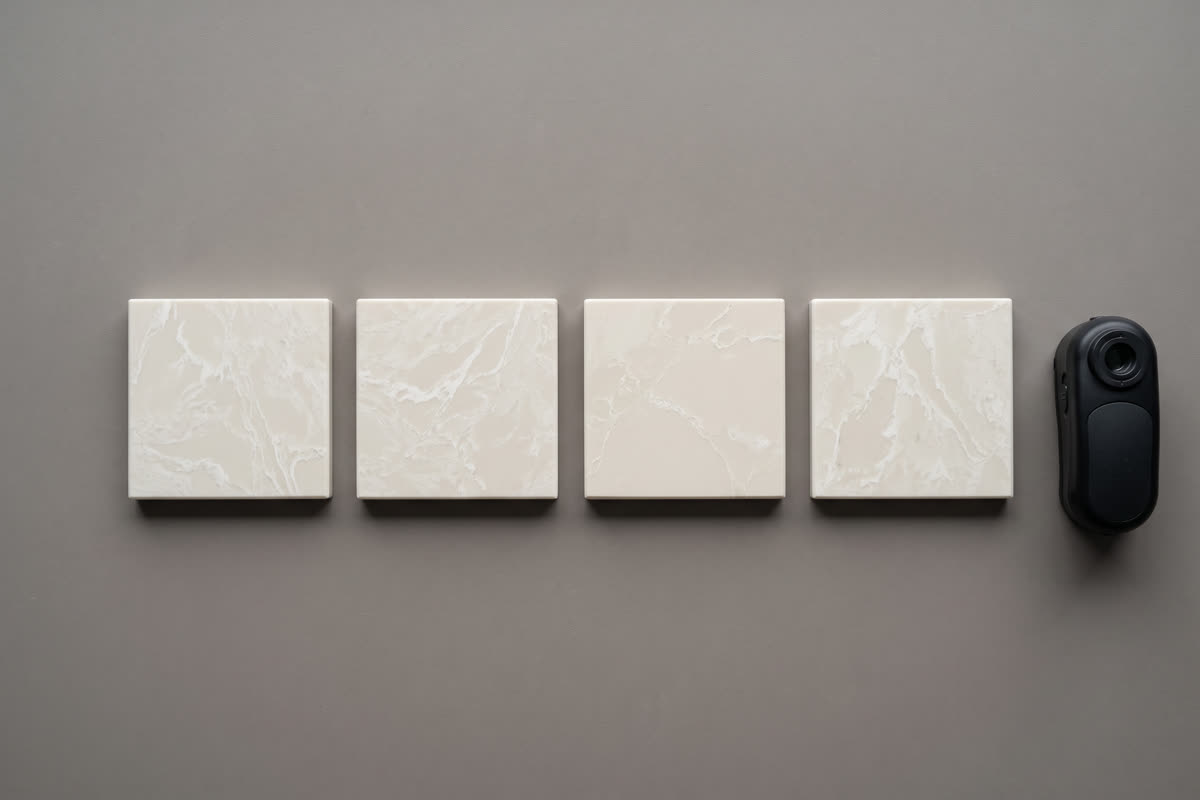
Measured colour, not judged colour. The eye is unreliable, adapts quickly and disagrees with itself under different lighting. A photo spectrometer measures the surface numerically, so a slab can be compared against a reference value rather than against someone's memory of it.
Checking bundles, not just slabs. Slabs are shipped in bundles, and variation can exist within one bundle as well as between production runs. Verification across both is what makes a stated tolerance meaningful.
Holding a reference. Keeping a physical reference for each design means later production is compared to a fixed original rather than to the batch immediately before it, which is how gradual drift creeps in unnoticed.
What to ask before a repeat order
- How is shade consistency measured, and is it measured or judged by eye?
- Is verification done across bundles as well as individual slabs?
- Can a sample be supplied from current production, rather than from an older reference set?
- If a project is phased, can material be reserved from the same batch?
That last question is often the most useful. For a phased project, reserving stock from one batch removes the problem entirely rather than managing it.
Frequently asked questions
- Why do quartz slabs vary in shade between batches?
- Engineered quartz is produced in discrete production runs. Small variations in pigment, aggregate and press conditions between runs can shift colour slightly. Within a batch the material is consistent; between batches it may not be.
- How do I avoid shade variation on a large project?
- Order the entire quantity from a single batch, including a wastage allowance, and have the batch number recorded on the order and the delivery paperwork. Splitting a project across deliveries is what introduces the risk.
- Can I reorder the same shade months later?
- You can reorder the same design, but not reliably the same batch. For projects likely to need later additions, order the contingency up front from the original batch rather than relying on a future match.
- Should slabs be dry-laid before installation?
- Yes, for any project where several slabs meet in one visual field. Dry-laying lets you sequence slabs so any variation falls where it is least visible, and it catches a mismatch while it is still cheap to solve.
SUNEX verifies shade with a photo spectrometer across slabs and bundles, so a later batch matches the first. See the range or request samples.