In short
Australia has banned engineered stone outright. Since 1 July 2024 the manufacture, supply, processing and installation of engineered stone is prohibited regardless of its silica content.
California is close to a ban above 1% silica. The STOP Act took effect in January 2026, and on 21 May 2026 the Cal/OSHA Standards Board voted unanimously to direct an emergency temporary standard prohibiting fabrication and installation of engineered stone above 1% crystalline silica. That standard is being drafted; it is not yet in force.
The United Kingdom is regulating rather than banning. On 11 May 2026 the HSE issued its first COSHH guidance sheet specific to engineered stone, alongside a programme of more than 1,000 fabricator inspections. The guidance names switching to low silica material as a control measure.
What survives all three is low or zero crystalline silica material. Conventional quartz can run to 95% crystalline silica. Q40 is under 40%, Q10 is under 10%, and crystalline silica free (CSF) is under 1% — the threshold California's proposed standard is written around.
Where the rules stand today
The three markets that matter most to anyone specifying or importing engineered stone have taken three different positions. Reading across them is what causes most of the confusion, because "engineered stone is banned" is true in one of them and false in the other two.
| Jurisdiction | Status | Effective | Scope |
|---|---|---|---|
| Australia | Full prohibition | 1 July 2024 | Manufacture, supply, processing and installation of all engineered stone, at any silica content |
| California, USA | STOP Act in force; ban above 1% silica directed and being drafted | STOP Act January 2026; board vote 21 May 2026 | Water-only cutting now; proposed prohibition on fabricating and installing engineered stone above 1% crystalline silica |
| United Kingdom | Enforcement and guidance, no ban proposed | HSE guidance 11 May 2026 | First COSHH guidance sheet for engineered stone; 1,000+ fabricator inspections across 2026/27; low silica material named as a control |
Why did Australia ban the material rather than regulate the dust?
Because the evidence suggested the dust could not be controlled reliably in practice. Australia's ban applies regardless of silica content, which is the detail most often missed: a low silica product does not re-enter the Australian market simply by being low silica.
Is engineered stone banned in the United States?
No, not nationally and not yet in any state. California is the furthest advanced. Its STOP Act, in force since January 2026, requires water-only cutting practices. The 21 May 2026 vote directs regulators to draft an emergency temporary standard going considerably further, prohibiting fabrication and installation above 1% crystalline silica. Until that standard is adopted, engineered stone remains legal to fabricate in California under the STOP Act's controls.
Is engineered stone banned in the UK?
No. The UK government has said a ban is not the approach it intends to take. The HSE is instead enforcing existing COSHH duties, backed by the guidance published on 11 May 2026 and a large inspection programme. Some unions, Unite among them, are pressing for a ban.
Why engineered stone specifically, and not all stone
Crystalline silica occurs in granite, sandstone and most natural stone. The reason engineered stone attracted regulation of its own is concentration and speed.
Conventional engineered quartz is natural quartz bound in resin, and can run as high as 95% crystalline silica — far above almost any natural stone. Where silica related disease in natural stone typically develops over decades, cases linked to engineered stone have appeared within months or a few years, and lung damage can be permanent before any symptom appears.
In California alone, more than 560 stoneworkers have been diagnosed with an aggressive form of silicosis. At least 31 have died since 2019, and close to 60 have needed lung transplants. Those are the numbers driving the regulation, and they explain why a material that is entirely inert once installed is treated as a workshop hazard rather than a consumer one.
What Q10, Q40 and CSF actually mean
A classification vocabulary has emerged alongside the regulation, and it is not yet used consistently. The thresholds themselves are simple.
| Term | Crystalline silica content | What it is for |
|---|---|---|
| Conventional engineered quartz | Commonly 85–95% | The material the regulation is aimed at |
| Q40 | Under 40% | A substantial reduction; still well above California's proposed 1% line |
| Q10 | Under 10% | A deeper reduction, below most natural stone |
| CSF (crystalline silica free) | Under 1% | Below the threshold California's proposed standard is written around |
Does low silica material cut differently?
No. Q10 and Q40 products run on the same diamond blades, CNC equipment and polishing pads as conventional quartz, so a workshop changing material does not change tooling.
Does low silica mean the dust controls can be relaxed?
No, and this is the most important thing on this page to get right. Lower silica content reduces the specific hazard the regulation targets. It does not make cutting dust harmless, and it does not remove any duty under COSHH or its equivalents. Water suppression, extraction, RPE and health surveillance all still apply.
What this means if you specify
For architects and interior designers the change is not aesthetic, it is a question of exposure. Specifying conventional engineered quartz now carries a professional liability dimension that did not exist a few years ago, particularly on projects that will be fabricated in a jurisdiction that has moved or is moving.
- Check where fabrication will happen, not only where the building is. The rules bite on the workshop, so a project in one market fabricated in another follows the fabricator's jurisdiction.
- Ask for the crystalline silica percentage in writing, not a marketing term. "Low silica" is not a defined threshold.
- Treat sintered and porcelain surfaces as a separate category. They fall outside the definition of engineered stone in both the Australian ban and California's STOP Act.
- Write the threshold into the specification where the project may outlive the current rules.
What this means if you fabricate
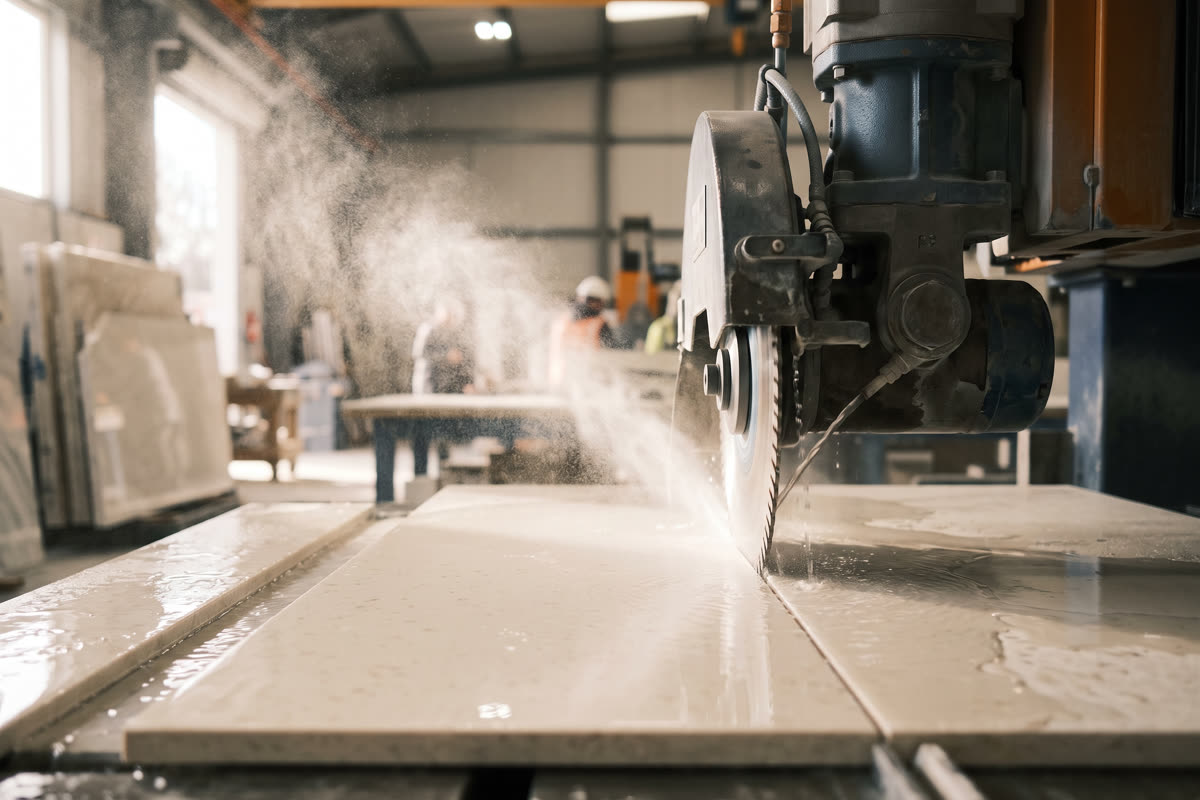
Dry cutting is finished as an accepted practice. It is explicitly prohibited under California's STOP Act and the HSE has been unambiguous that it must stop in the UK, having already ordered fabricators to halt work. The practical list is short and none of it is new; what has changed is that it is now being inspected.
- Water suppression on every tool that generates dust, with mist controlled rather than simply created.
- Local exhaust ventilation, maintained and tested rather than installed and forgotten.
- RPE that is face fit tested for the individual wearing it.
- Health surveillance, which is what finds damage before symptoms do.
- Material substitution to low or zero silica, which the HSE guidance names directly.
What this means if you import or distribute
Two forces are acting on the same stock at once, and they pull in different directions. Regulation is pushing demand towards low silica material. Trade measures are making conventional quartz from some origins more expensive to land in the United States regardless of its silica content.
For a distributor the question worth asking now is not only what sells this quarter, but what is still legal to fabricate and economic to land in the markets you serve in two years. Stock bought today on a five year view is being bought into a moving regulatory position.
Frequently asked questions
- Is engineered stone banned?
- In Australia, yes — since 1 July 2024 all engineered stone is prohibited regardless of silica content. In the United States it is not banned nationally; California has the STOP Act in force since January 2026 and, following a Cal/OSHA Standards Board vote on 21 May 2026, an emergency temporary standard banning engineered stone above 1% crystalline silica is being drafted. In the United Kingdom there is no ban and the government has said one is not intended; the HSE is enforcing COSHH duties instead.
- What is the difference between Q10, Q40 and crystalline silica free quartz?
- They are thresholds for crystalline silica content. Q40 is under 40%, Q10 is under 10%, and crystalline silica free (CSF) is under 1%. Conventional engineered quartz commonly runs between 85% and 95%. The 1% figure matters because it is the line California's proposed standard is written around.
- Is crystalline silica free quartz safe to cut without dust control?
- No. Reducing crystalline silica content reduces the specific hazard the regulation targets, but cutting any stone produces respirable dust and every duty under COSHH or equivalent legislation still applies. Water suppression, extraction, fit-tested RPE and health surveillance remain necessary.
- Does low silica quartz need different fabrication equipment?
- No. Q10 and Q40 materials are cut and finished with the same diamond blades, CNC equipment and polishing pads as conventional engineered quartz, so a workshop can change material without changing tooling.
- Are porcelain and sintered stone affected by the engineered stone bans?
- No. Sintered and vitrified surfaces such as porcelain fall outside the definition of engineered stone used in both the Australian ban and California's STOP Act. They are regulated as their own category.
- If a project is designed in one country and fabricated in another, whose rules apply?
- The fabricator's. These rules are occupational health measures and they bite where the cutting happens, so the jurisdiction of the workshop governs, not the jurisdiction of the building.
SUNEX manufactures CSF material below 1% crystalline silica across all 39 designs at its own plant in Jaipur, India, and can supply the crystalline silica percentage in writing for specification. See the range or request samples.