In short
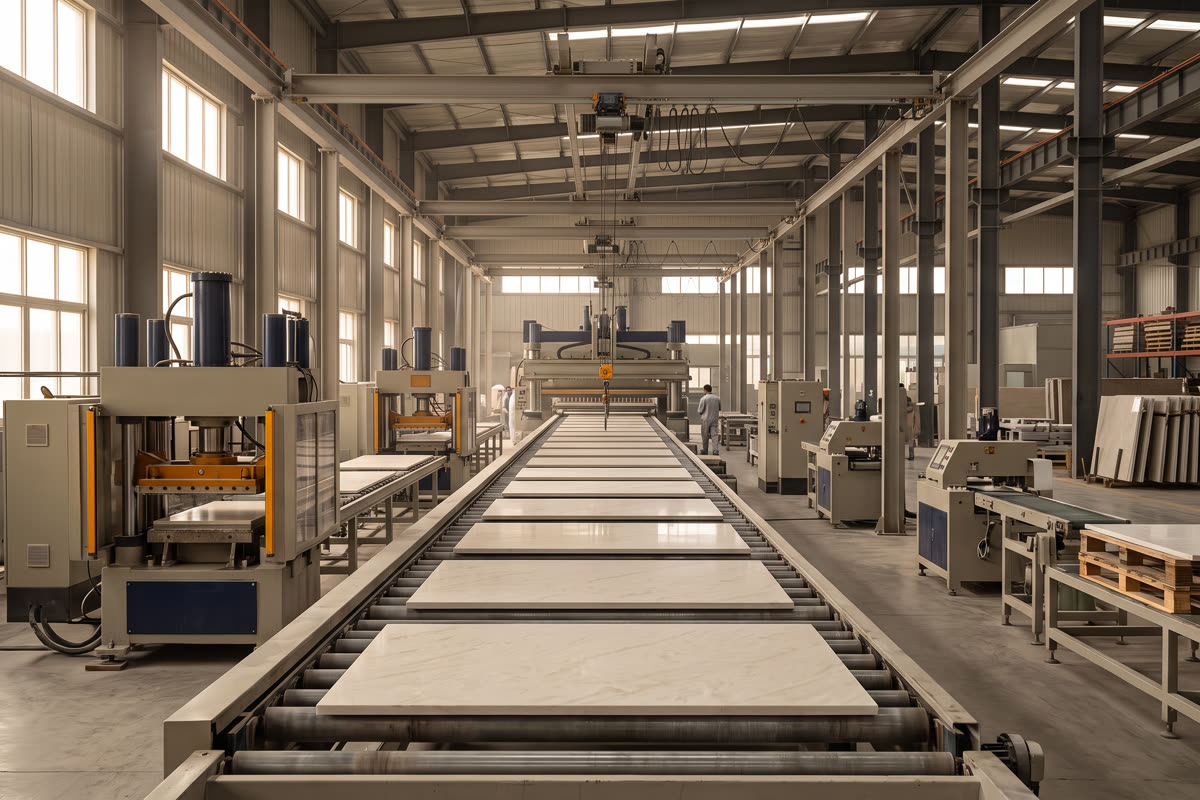
The questions that separate a manufacturer from a trader are specific and verifiable: who owns the plant, what the monthly capacity is, what the crystalline silica percentage is in writing, which certifications are held and can be produced, what the batch policy is for large orders, and whether samples come from current production rather than an old sample box.
Do you manufacture, or do you trade?
This is the first question and it changes every answer after it. A trading house buys finished slabs and resells them. A manufacturer owns the process.
It matters because a trader cannot control consistency between batches, cannot commit to capacity, and cannot usually tell you which plant produced a given slab. If a problem appears, they are relaying it to someone else.
Ask directly, and ask which lines the material runs on.
What is your actual monthly capacity?
Not the largest order ever shipped. The sustainable monthly figure. It tells you whether your growth fits inside their operation or will eventually collide with it.
A supplier comfortable with the question will answer in containers per month without hesitating.
What sizes and thicknesses, across which designs?
Ranges are often quoted at their maximum. Confirm which formats are available across the whole range rather than on a handful of designs, and check that a design you intend to stock is not the exception.
How is consistency handled between orders?
Covered in more depth separately, but at minimum ask whether shade is measured instrumentally, whether verification covers bundles, and whether material can be reserved from a batch for a phased project.
Is crystalline silica free available, and on what?
Regulation is tightening in several markets. A supplier offering CSF across the full range gives you room to move if your market changes. One offering it on four designs does not.
What certifications do you hold?
ISO 9001 covers quality management, ISO 14001 environmental management. Greenguard concerns indoor air quality and NSF relates to food contact surfaces. Which matter depends on where you sell, and some specifications will require them.
What happens when something goes wrong?
The most revealing question, and the one most often left unasked. Slabs get damaged in transit. Batches occasionally miss. What matters is what happens next.
- Who do you contact, and do they answer in your working hours?
- How are claims assessed, and what evidence is required?
- Is replacement material drawn from the same batch?
- How long does resolution actually take?
A supplier who has thought about this will have ready answers. One who has not will talk about how rarely it happens, which is not an answer.
Can I see current production?
Ask for samples from current output rather than a sample box assembled some time ago. It tells you what you would actually receive, and a manufacturer confident in their consistency will not hesitate.
Frequently asked questions
- How do I check a quartz supplier actually manufactures?
- Ask who owns the plant, where it is, and what its monthly capacity is, then ask for samples from current production rather than a prepared sample box. A manufacturer can answer all of that immediately; a trader generally cannot.
- What certifications should an engineered quartz manufacturer hold?
- Expect the supplier to produce documentation on request rather than describe it. Which certifications matter depends on your market, so ask which are held, ask to see the certificates, and check they are current and cover the product you are buying.
- What should I ask about crystalline silica content?
- Ask for the percentage as a figure, in writing, for the specific product. Terms such as low silica are not defined thresholds, and the figure is what a specification and any future regulatory check will rest on.
- What is a reasonable minimum order quantity for quartz slabs?
- It varies by manufacturer and market. The more useful question is what the batch policy is on a large order, because a supplier willing to reserve one batch for your whole project is solving the problem most likely to cost you money.
SUNEX manufactures its own material in Jaipur, India, with capacity of 250 containers a month and CSF available across all 39 designs. See the range or request samples.